




Humane Harvest.
Sedating fish with SED8 before and during slaughter protects animal welfare, preserves muscle quality, extends shelf life, and directly improves the commercial value of every fish you bring to market.
Welfare and Quality Are the Same Problem.
The quality of a fish fillet is not determined only by genetics, feeding, and water quality across the grow-out cycle. It is also determined – in a surprisingly large part – by what happens in the final minutes of that fish’s life. The physiological state of the animal at the moment of slaughter has a direct and measurable effect on muscle biochemistry, and that biochemistry shapes every quality attribute a buyer or consumer will use to evaluate the product.
This is not unique to fish. The same principle is well established across livestock and poultry processing: animals that experience high levels of stress before slaughter produce inferior meat. The mechanism is the same in fish. When a fish is crowded, netted, pumped, and lifted – struggling against capture in the minutes before death – it burns through its muscle energy reserves at an accelerated rate. The results of that energy depletion show up in the fillet as poor texture, premature rigor, gaping, blood spotting, shortened shelf life, and reduced yield. A humane harvest approach using SED8 addresses the welfare problem and the quality problem in a single intervention.

Zero Withholding Period
SED8 is registered with a zero food-fish withholding period in all approved territories. Fish sedated during harvest go directly to slaughter and processing – no delay, no residue concern, no constraint on food chain access
Why Conventional Harvest Damages Muscle Quality.
Not all killing methods are equal. For a method to be considered humane, it must satisfy a set of interconnected welfare criteria – addressing not just the moment of death, but the entire experience of the animal from the point at which it is isolated through to confirmed cessation of consciousness.

Premature Rigor Mortis
With ATP reserves depleted at death, rigor mortis sets in rapidly – sometimes within hours. Fish entering rigor quickly are harder to process cleanly and produce lower-yield, more damaged fillets.

Soft Texture & Poor Colour
Low muscle pH alters the structural integrity of muscle proteins. Fillets become pale, soft, and prone to moisture loss – reducing both visual appeal and cooking performance.

Fillet Gaping
Gaping – the separation of muscle blocks along connective tissue seams is strongly linked to harvest stress. It makes fillets visually unappealing and is particularly damaging for premium products like smoked salmon and sashimi.

Blood Spotting
Intense physical exertion weakens small blood vessels in the muscle. These rupture under the strain of escape behaviour, causing pools of blood to form in the white muscle tissue – a visible defect that downgrades fillet grade.

Reduced Shelf Life
Depleted muscle energy reserves accelerate autolytic breakdown and subsequent microbial spoilage. Stressed fish arrive at point-of-sale in a more advanced state of deterioration, narrowing the marketable window.

Scale Loss & External Damage
Physical trauma during crowding and netting causes scale loss, fin damage, and bruising. Where fish are sold whole, this external damage reduces consumer acceptance and depresses price.
How SED8 Humane Harvest Changes the Outcome.
When SED8 is added to the harvest water at a sedation dose, fish cease escape behaviour before or shortly after crowding begins. They remain upright and continue to ventilate, but the full flight response is suppressed. Muscle ATP is preserved. Lactic acid accumulation is slowed. The fish arrives at slaughter with its energy reserves largely intact – and that difference is visible and measurable in the finished product.

Delayed Rigor Onset
Preserved muscle ATP extends the pre-rigor window significantly – in some species by 12 hours or more compared to conventionally harvested fish. This makes processing easier, safer, and higher-yield.

Firmer, Better-Coloured Fillets
Higher post-mortem muscle pH produces fillets with improved texture, translucency, and colour. The product looks better on the slab and performs better in the kitchen.

Reduced Gaping
Lower pre-slaughter stress substantially reduces the frequency and severity of gaping in stored fillets – a key quality metric for smoked, raw, and value-added product lines.

Cleaner Fillets
Sedated fish sustain fewer vascular injuries during harvest. Blood spotting is significantly reduced, supporting higher average fillet grade across the batch.

Extended Shelf Life
Intact muscle energy reserves slow autolytic and microbial activity post-harvest. SED8 humane harvest fish retain prime eating quality for longer – opening access to more distant markets.

Better Whole-Fish Presentation
Reduced physical handling trauma means fewer scales lost and less visible external damage – directly supporting premium whole-fish sales and display quality.
Species & Scale Considerations.
Humane harvest using SED8 is applicable across the full spectrum of commercially farmed species and production scales. The economic case varies somewhat by species value and end market, but the principle holds across all scenarios.
High-value species such as Atlantic salmon, Chinook salmon, and bluefin tuna are already subject to careful individual attention during slaughter – techniques like Iki Jime and precise bleeding are standard practice – because the premium paid for superior flesh quality is substantial. For these species, SED8 humane harvest sedation provides an additional upstream intervention that protects the quality gains achieved downstream at the point of slaughter.
For mid-value species like barramundi, seabream, seabass, and trout, humane harvest delivers measurable improvements to fillet grade and shelf life that translate directly into better market returns with relatively modest changes to existing harvest procedures.
For higher-volume, lower-unit-value species – including tilapia, catfish, carp, perch, and similar species typically processed in bulk – humane harvest has historically received less attention, but the quality gains it delivers are no less real. Published isoeugenol data on channel catfish and tilapia demonstrate significant improvements in muscle pH, blood lactate, and fillet quality metrics in isoeugenol harvested groups compared to conventionally harvested controls
Induction times Vary by Species and Condition.
Well-nourished, rested fish typically take longer to reach full sedation than fatigued or nutritionally depleted individuals. Always conduct a species trial at your target site conditions before scaling up, and allow adequate exposure time before commencing crowding and slaughter operations.
Humane Harvest vs. Conventional Harvest: A Quality Comparison.
| Quality Indicator | Conventional Harvest | SED8 Humane Harvest |
|---|---|---|
| Rigor mortis onset | Rapid (1–3 hours in stressed fish) | Delayed (12+ hours in sedated fish) |
| Muscle pH at death | Low (rapid lactic acid accumulation) | Higher and sustained for longer post-slaughter |
| Fillet texture | Soft, prone to structural breakdown | Firmer, more resilient during processing |
| Gaping incidence | High, especially in stored/processed fillets | Significantly reduced |
| Blood spotting | Common due to vascular rupture | Significantly reduced |
| Shelf life | Shorter; autolysis advances faster | Extended; slower degradation from harvest |
| Scale & external condition | High scale loss and physical damage | Improved; minimal trauma during crowding |
| Fillet yield | Reduced by drip loss and processing damage | Improved water-holding capacity and higher yield |
Continuous-Flow Harvest System.
The most operationally efficient way to implement SED8 humane harvest at commercial scale is a continuous-flow system with defined staging zones. Fish move progressively through sedation and into the slaughter area, ensuring a steady supply of appropriately anaesthetised animals throughout the harvest shift without the need for individual handling.
A well-designed continuous-flow system uses three zones, each serving a distinct function. Fish spend approximately five minutes in each zone before being advanced to the next. Progression between zones is managed by lowering the net partitions between sections and gently moving fish forward – no pumping or lifting is required between zones, which preserves the sedation level and minimises additional stress between stages.
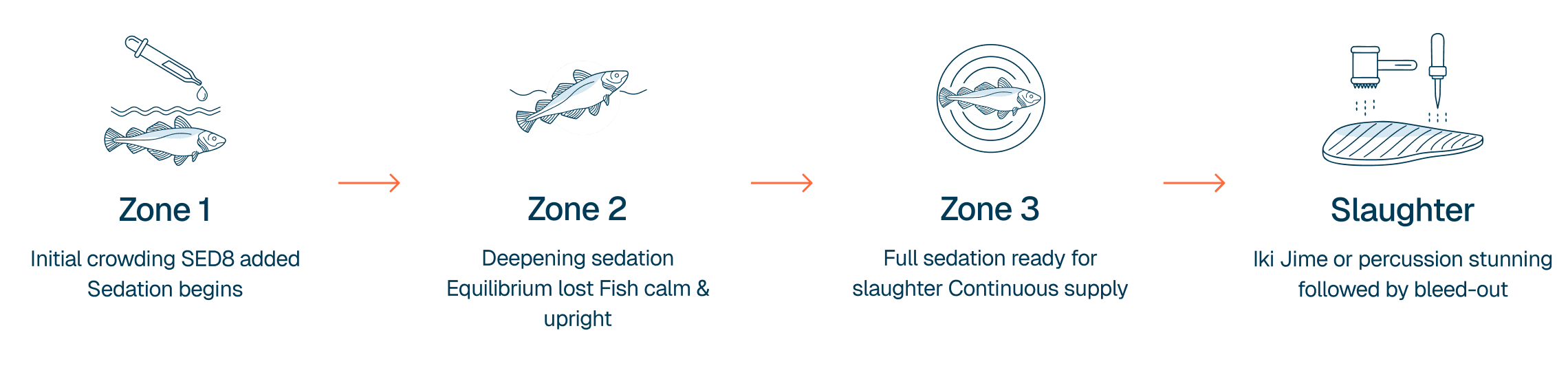
Only fish that have passed through the full three-zone sequence – and that are confirmed to be at the appropriate sedation level – are advanced to slaughter. This quality-control gate ensures consistency across the harvest and prevents incorrectly sedated fish from entering the processing line.
Step-by-Step Harvest Procedure.
The following protocol is suitable for cage-based or tank-based harvest operations. Adapt zone sizes and SED8 volumes to your system capacity using the SED8 concentration calculator.

Set up the Harvest Pen or Crowding Area
Prepare Zone 1 as you would for a standard harvest crowding event. Ensure aeration is functioning across all zones before fish are introduced. Confirm that water temperature and salinity match the fish’s holding conditions.

Calculate and Prepare the SED8 Dose
Using the SED8 concentration calculator, determine the product volume required for your target ppm across each zone’s water volume. Prepare stock solutions and have them ready to add simultaneously at the start of crowding.

Begin Crowding and Add SED8 to Zone 1
As fish are guided into the crowding area, disperse the SED8 stock solution evenly throughout the zone. Distribute the solution around the perimeter to ensure even mixing. Avoid any pump or turbulence that could add additional stress before sedation takes effect.

Allow 5 Minutes per Zone; Dose Subsequent Zones
After approximately 5 minutes in Zone 1, lower the net partition and allow fish to move forward into Zone 2. Repeat for Zone 3. Maintain SED8 dose levels in each zone throughout the harvest to ensure fish are not recovering. Observe that fish become progressively less responsive to external stimuli as they advance.

Confirm Sedation Depth Before Slaughter
Fish ready for slaughter should show loss of equilibrium and minimal or no response to a gentle stimulus. Do not advance fish to slaughter if they are still actively swimming or responding strongly – allow additional time in Zone 3 and check that SED8 concentration is at the correct level.

Slaughter Sedated Fish Immediately
Apply the chosen slaughter method – Iki Jime brain spike, percussion stunning, or electrical stunning – to fully sedated fish as they exit Zone 3. Proceed directly to bleed-out. The combination of chemical sedation and a reliable primary slaughter method provides both a welfare-optimal outcome and the highest possible muscle quality at slaughter.

Bleed and Chill Promptly
Transfer bled carcasses to ice slurry or chilled water immediately after slaughter. Rapid chilling arrests biochemical activity in the muscle and locks in the quality advantages gained during the humane harvest process. Process or package before rigor mortis is fully established where possible.
Recommended Dose Reference.
The following concentrations are indicative guidelines for humane harvest sedation. Effective doses vary with species, water temperature, fish condition, and system design. Always trial before full-scale deployment.
| Species Group | SED8 Sedation Dose (ppm) | Typical Induction Time |
|---|---|---|
| Atlantic & Pacific Salmon | 15 – 20 ppm | 5 – 15 min (longer in rested, well-fed fish) |
| Trout (rainbow, brown) | 12 – 18 ppm | 3 – 10 min |
| Barramundi / Asian Seabass | 15 – 25 ppm | 5 – 12 min |
| Seabream & Seabass | 15 – 20 ppm | 5 – 10 min |
| Tilapia, Catfish & Carp | 20 – 35 ppm | 3 – 10 min |
| Tuna & Large Pelagics | Contact SED8 technical support | Species trial required |
All doses expressed as ppm isoeugenol active ingredient. Use the SED8 concentration calculator to verify product volumes for your zone or vessel size. Doses stated are for sedation prior to slaughter – not euthanasia overdose concentrations.
The Commercial Case.
Humane harvest is sometimes presented as a welfare initiative – a cost that responsible producers accept. In reality, the economics of humane harvest are straightforward. The quality improvements it delivers are not marginal. Extended shelf life opens access to export markets that conventional harvest cannot reach. Improved fillet grade distribution means fewer kilograms downgraded to lower-value product categories. Reduced gaping and blood spotting protects revenue in premium and value-added product lines. Higher fillet yield from better water-holding capacity reduces per-kilogram processing losses.
For operations already working to quality certification frameworks such as ASC, GlobalG.A.P., or RSPCA Assured, SED8 humane harvest provides a documented, auditable welfare management practice that supports certification and demonstrates responsible production to increasingly discerning retail and food service customers.
When welfare and commercial outcomes point in the same direction – as they do here – implementation is not a trade-off. It is the obvious choice
The Commercial Case.
Humane harvest is sometimes presented as a welfare initiative – a cost that responsible producers accept. In reality, the economics of humane harvest are straightforward. The quality improvements it delivers are not marginal. Extended shelf life opens access to export markets that conventional harvest cannot reach. Improved fillet grade distribution means fewer kilograms downgraded to lower-value product categories. Reduced gaping and blood spotting protects revenue in premium and value-added product lines. Higher fillet yield from better water-holding capacity reduces per-kilogram processing losses.
For operations already working to quality certification frameworks such as ASC, GlobalG.A.P., or RSPCA Assured, SED8 humane harvest provides a documented, auditable welfare management practice that supports certification and demonstrates responsible production to increasingly discerning retail and food service customers.
When welfare and commercial outcomes point in the same direction – as they do here – implementation is not a trade-off. It is the obvious choice